
Commercial Rooftop Unit Maintenance for Restaurants
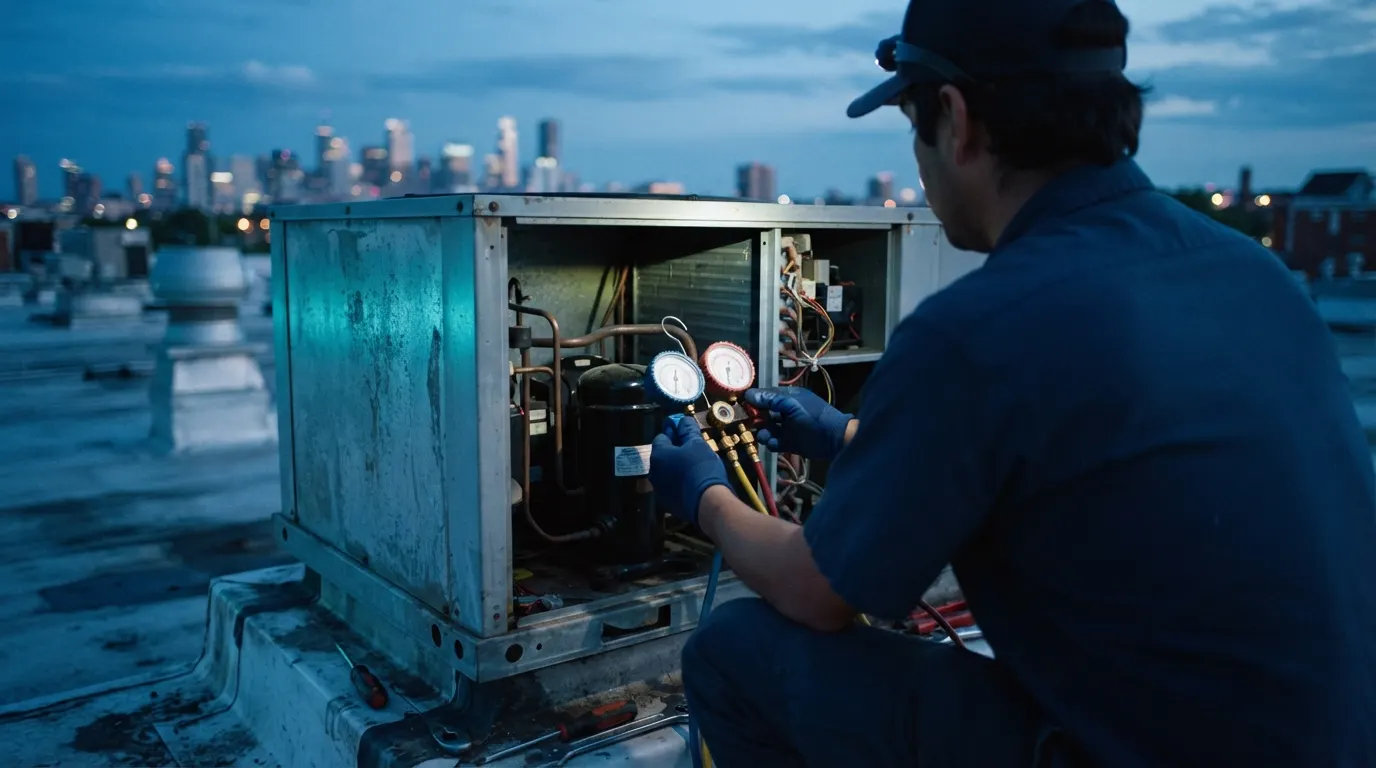
Restaurant rooftop units fail faster than office units because they run longer hours in grease-laden air. Filter changes, coil cleaning, belt and drain checks, and catching short-cycling early prevent most mid-service cooling failures. This is a maintenance guide, not a diagnosis of a unit that has already stopped cooling.
A rooftop unit serving a restaurant kitchen is not the same job as a rooftop unit serving an office. It runs longer hours, it sits in grease-laden exhaust, and when it fails it fails during service. Most of those failures are not sudden. Filters load, coils coat, belts stretch, condensate drains clog, and the compressor starts short-cycling weeks before the kitchen notices the dining room is warm. This guide is for operators who want to keep a working rooftop unit working. If the unit has already stopped cooling, that is a different problem — diagnose it as a failure, not as a missed filter change.
Why restaurant rooftops wear out faster
Kitchen exhaust puts grease, moisture, and cooking vapour into the air around the roof. That mixture coats condenser coils, loads filters faster than a typical commercial space, and can work its way into outdoor cabinets. Combined with long operating hours — many kitchens run the unit from open to close, seven days a week — the result is a unit that is working harder in a dirtier environment than the schedule it was designed around.
What to check between service visits
- Filters. A loaded filter chokes airflow, which makes the unit run longer, ice the indoor coil, and eventually trip on a safety. Restaurant filters often need changing more often than the manufacturer interval written for a clean office.
- Outdoor coils. Look for a grey or greasy film on the condenser. A coated coil cannot reject heat, so the compressor works harder and cooling capacity drops even though the unit is still running.
- The condensate drain. If the pan is full or water is staining the ceiling below the unit, the drain is restricted. That can shut the unit off on a float switch, or it can leak into the building.
- Unusual sounds or short-cycling. A unit that starts, runs a short time, and stops repeatedly is telling you something is wrong — airflow, refrigerant, a failing capacitor, or a control issue. Do not keep resetting it.
- The area around the unit. Debris, grease buildup on the roof, and blocked clearances all reduce airflow across the condenser.
What a technician looks at that staff cannot
- Belt condition and tension on belt-driven blowers.
- Capacitors, contactors, and electrical connections that fail from heat and vibration.
- Refrigerant charge and signs of a leak — oil residue on lines, icing that does not match a dirty-coil pattern.
- Economizer dampers stuck open or closed, which either dumps unconditioned air into the space or wastes the free-cooling the unit was built for.
- Whether the unit is actually matched to the load, or whether a hood and make-up air imbalance is making a healthy unit look undersized. That last one is a ventilation problem, not a rooftop problem, and it is covered separately.
How often is enough
There is no single interval that fits every kitchen. A rooftop over a fryer-heavy line in a building that runs long hours needs attention more often than a dining-room-only unit. A practical starting point for most foodservice operators is a professional inspection at least twice a year, with filter changes on a much shorter cycle in between. A technician who has seen the equipment can set a real interval from how dirty it actually is, not from a generic calendar.
What this guide is not
This is not a troubleshooting walkthrough for a rooftop that has already stopped cooling, and it is not a diagnosis of a kitchen that stays hot while the air conditioning runs. A unit that is off, locked out, or blowing warm air needs a service call. A kitchen that is hot while the dining room is comfortable often has a make-up air or hood-balance issue rather than a rooftop issue.
If you want a rooftop unit inspected before the next busy stretch, or if it is already short-cycling or losing capacity, book a commercial HVAC service call.
Who you’re asking
This is written from the work Pierre Refrigeration Services does every week in commercial kitchens across Metro Atlanta. Owner Don Pierre has spent 20 years in commercial refrigeration and HVAC and established the business in 2014. Refrigeration and HVAC are handled by the same company, which is why these guides treat a fault as a building problem rather than one trade’s problem.
Related questions
- Why do restaurant rooftop units fail sooner than office ones?
- Because they sit downwind of a kitchen exhaust. Grease from the hood settles on the condenser coil and holds dust, which is a far harder load than the same unit would see on an office roof.
- How often should a unit be serviced?
- Twice a year is the usual pattern — before cooling season and before heating season — with coil cleaning more often where hood exhaust reaches the unit. Condition drives it more than the calendar does.
- What can be checked without going on the roof?
- Whether the unit is short-cycling, whether supply air is actually cold, and whether filters are loaded. Those three narrow the problem considerably before anyone climbs.
- Is short-cycling something to act on quickly?
- Yes. Every start is the hardest moment in a compressor’s life, and a unit cycling every few minutes does that hundreds of times a day. It is a symptom that damages the thing it is a symptom of.
Need service?
Book online or call to schedule.
Book online